02 de dez · Tecnologia
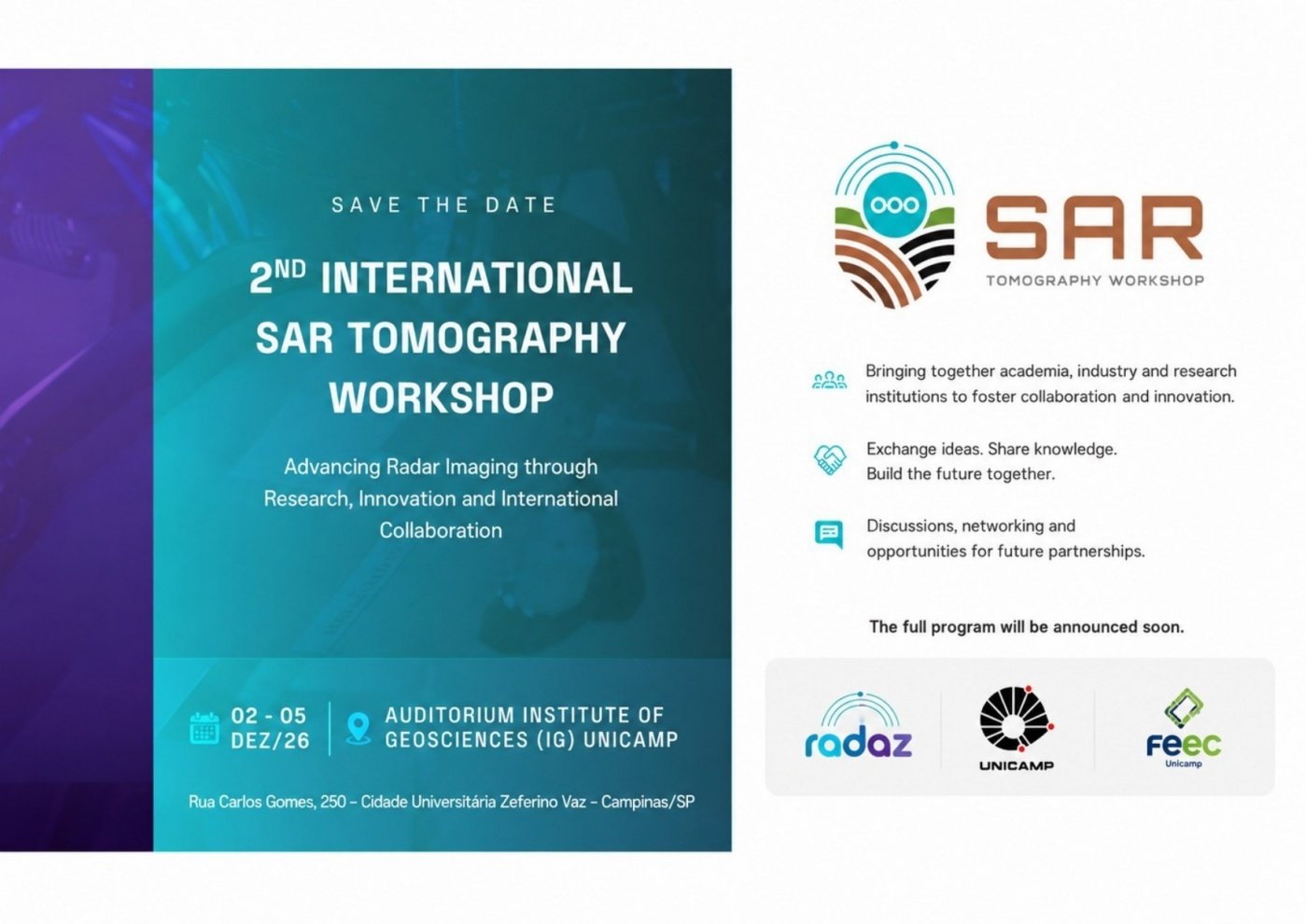
The Second International Workshop on SAR Tomography
Comprar · a partir de R$ 10,00
A compra acontece no site da Sympla. Com taxa, a partir de R$ 13,99.
Sobre o evento
The Second International Workshop on SAR Tomography will
bring together leading researchers, engineers, students, and industry
professionals to discuss the latest advances in synthetic aperture radar, radar
tomography, interferometry, polarimetry, multidimensional imaging,
electromagnetic modeling, inverse problems, artificial intelligence, and
emerging radar architectures.
To be held at the University of Campinas – Unicamp, Brazil,
from December 2 to 4, 2026, the scientific program will feature plenary and
invited lectures addressing spaceborne, airborne, and UAV-borne SAR systems,
with applications in forestry, agriculture, geology, volcanology, environmental
monitoring, infrastructure, natural hazards, and surface and subsurface
imaging.
The workshop is organized by RADAZ in collaboration with
researchers from the School of Electrical and Computer Engineering and the
Institute of Geosciences at Unicamp, with the participation of the IEEE
Aerospace and Electronic Systems Society and IEEE Geoscience and Remote Sensing
Society Student Branch Chapters. Confirmed plenary speakers include Prof.
Kun-Shan Chen, from Nanjing University, Prof. Henrik Persson, from the
Swedish University of Agricultural Sciences, Prof. Stefano Tebaldini, from Politécnico di Milano, Dr. Sandeep Gogineri, from Information Systems Laboratory, Inc., and Igal Bilik, from Ben Gurion University of the Negev.
On Saturday, December 5, participants will also be invited
to a special Industry and Technology Day at Unicamp, featuring live flight
demonstrations of the Brazilian-developed RADAZ RD350 multiband P-, L-, and
C-band UAV-SAR system, followed by demonstrations of SAR image formation and
three-dimensional tomographic product generation.
More than a scientific meeting, the workshop is intended as
an international forum for exchanging knowledge, presenting breakthrough radar
technologies, fostering new collaborations, and exploring how next-generation
SAR tomography can reveal structures hidden beneath vegetation, soil, ice, and
other complex environments.